The diamond industry has changed. Lab grown diamonds have made diamond-quality stones accessible to more buyers than ever before. But there’s another contender that’s been quietly gaining ground — moissanite — and it makes a strong case at a very different price point.
If you’re deciding between moissanite and a lab grown diamond, you’re not comparing “real vs fake.” You’re comparing two legitimate, lab-created gemstones with different properties, different price tags, and different strengths.
Here’s the honest breakdown.
Quick Answer
Moissanite costs 80–90% less than a lab grown diamond per carat. In terms of brilliance, it actually outperforms diamonds optically. In terms of hardness, it’s marginally below diamond but still scratch-resistant for lifetime wear. Lab grown diamonds hold the advantage if you want the prestige of diamond or slightly closer visual match to natural diamonds. Moissanite wins if you want maximum sparkle per dollar spent.
What Are Lab Grown Diamonds?
Lab grown diamonds are chemically, physically, and optically identical to natural (mined) diamonds. The only difference is origin — they’re created in a laboratory using one of two methods:
- HPHT (High Pressure, High Temperature): Mimics the natural conditions deep in the Earth’s mantle
- CVD (Chemical Vapor Deposition): Grows diamond crystal layer by layer from carbon gas
The resulting stone is real diamond — same carbon crystal structure, same hardness (10 on Mohs), same refractive index (2.42), same everything. A gemologist cannot distinguish a lab grown diamond from a mined diamond without specialized testing.
Lab grown diamonds carry the same certifications (GIA, IGI) as natural diamonds. Prices have dropped dramatically in recent years — 40–60% in some markets — as production capacity has scaled up.
How Moissanite Differs
Moissanite is silicon carbide, not carbon. It’s a genuinely different material with its own properties:
- Composition: Silicon carbide (SiC)
- Hardness: 9.25 Mohs (second only to diamond)
- Refractive Index: 2.65 (higher than diamond’s 2.42)
- Fire (Dispersion): 0.104 (more than double diamond’s 0.044)
- Origin: 100% lab-created — no natural source exists at gemstone scale
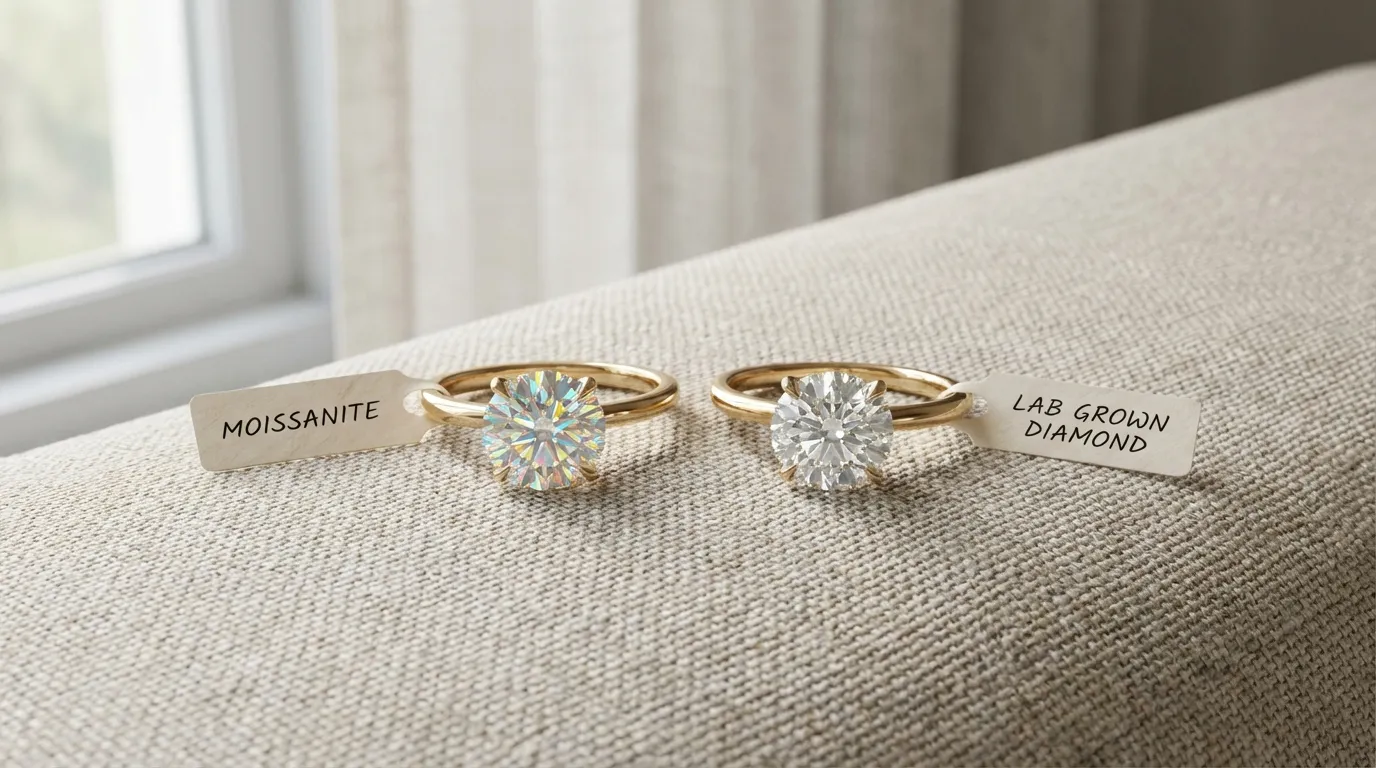
The critical difference is in light performance. Moissanite bends light more aggressively than diamond, producing more brilliance (white light return) and significantly more fire (rainbow color flashes). Under direct light, moissanite is the more visually dramatic stone.
The Full Comparison Table
| Feature | Moissanite | Lab Grown Diamond |
|---|---|---|
| Composition | Silicon carbide | Pure carbon |
| Hardness (Mohs) | 9.25 | 10 |
| Refractive Index | 2.65 | 2.42 |
| Fire (Dispersion) | 0.104 | 0.044 |
| Price per carat (1 ct) | $300–$600 CAD | $800–$2,000 CAD |
| Resale Value | Minimal | Minimal |
| Ethical Status | Lab-created, no mining | Lab-created, no mining |
| Certification | Moissanite grading reports | GIA / IGI certification |
| Visually identical to natural diamond? | No (more fire) | Yes |
Price Comparison
This is where moissanite makes its strongest argument.
| Stone | 1 Carat | 2 Carat | 3 Carat |
|---|---|---|---|
| Moissanite | $300–$600 CAD | $700–$1,200 CAD | $1,200–$2,000 CAD |
| Lab Grown Diamond | $800–$2,000 CAD | $2,500–$5,000 CAD | $5,000–$9,000 CAD |
The gap widens substantially at larger sizes. A 3-carat lab grown diamond costs roughly 4–5x more than an equivalent moissanite. For buyers who want a larger, statement stone, moissanite delivers dramatically more per dollar.
Brilliance and Fire
Both stones are beautiful. But they’re beautiful differently.
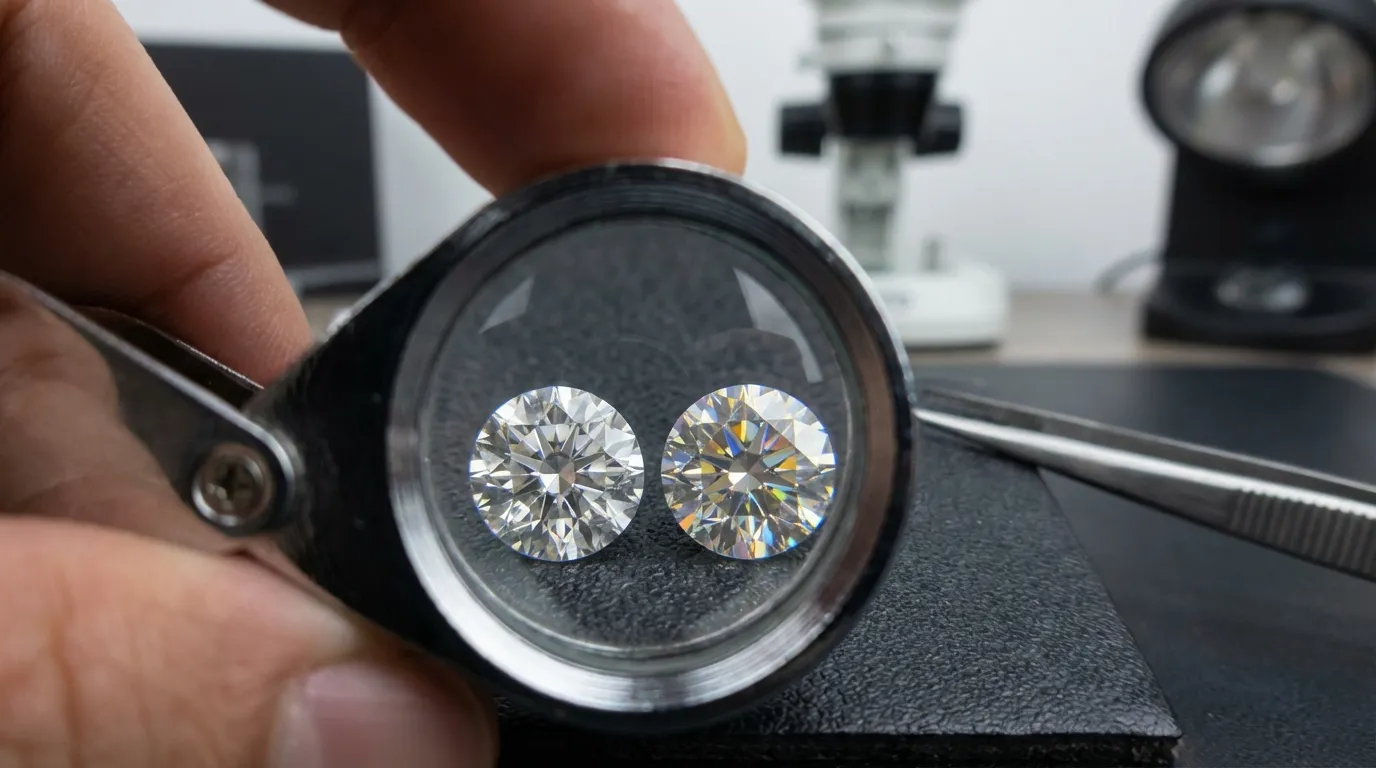
Lab grown diamonds produce the classic white brilliance that’s defined luxury jewelry for generations. Their fire (0.044) creates subtle color flashes — elegant and restrained. Under most lighting, lab diamonds look identical to their natural counterparts.
Moissanite produces more light output overall. Its higher refractive index means more white light return, and its dispersion rate of 0.104 is more than double diamond’s. In direct sunlight or under spotlights, moissanite throws vivid rainbow flashes that lab diamonds cannot match.
Which is better? This comes down to personal taste:
- If you want diamond-exact visual behavior — lab grown diamond
- If you want maximum sparkle and fire — moissanite
- If you want value without compromise — moissanite
Durability for Daily Wear
Both stones are excellent for daily wear. The Mohs scale is ordinal (not linear), and the practical difference between 9.25 and 10 is smaller than it sounds.
What matters for daily wear:
- Moissanite won’t scratch from normal activity — it’s harder than any material typically encountered in daily life
- Neither stone will cloud, fade, or lose brilliance over decades
- Both can be set, re-set, resized, and cleaned without damage
For engagement rings, daily rings, and fine jewelry intended for long-term use, moissanite is completely appropriate. There’s no practical durability argument for lab diamonds in the context of jewelry wear.
Resale Value
Here’s the uncomfortable truth about both options: neither holds resale value well.
Lab grown diamond prices have dropped 40–60% since 2020 as production has scaled massively. A $2,000 lab diamond purchased in 2022 might sell for $600–$800 secondhand today. That trajectory is likely to continue.
Moissanite has essentially no secondary market — it sells for very little secondhand.
If resale value matters to you, natural mined diamonds still hold value better than either alternative — but even natural diamonds lose significant value the moment they leave the store.
For most buyers, jewelry should be purchased for enjoyment, not investment. On that basis, moissanite offers the best experience per dollar spent.
Which Should You Choose?
Choose moissanite if you:
- Want the best sparkle for your budget
- Are buying at 2+ carats where price differences are extreme
- Prioritize durability and lifelong brilliance over prestige
- Want to buy multiple pieces (moissanite’s price point makes this accessible)
- Value ethics and sustainability
Choose a lab grown diamond if you:
- Specifically want a diamond (the material, the story, the carbon)
- Want the closest visual match to a natural diamond
- Value GIA/IGI certification and diamond grading language
- Are buying for someone who specifically wants a diamond
- Are in a cultural context where diamond is expected
There is no wrong answer here. Both are beautiful, ethical, lab-created stones. The decision comes down to what you’re optimizing for.
How Moissanite Compares to Other Alternatives
If you’re still researching, our complete moissanite vs diamond guide covers the full natural vs lab-grown vs moissanite spectrum. We also have a detailed breakdown of moissanite vs cubic zirconia if you’re comparing moissanite with more budget-oriented options.
Shop Moissanite
Ready to explore moissanite for yourself?
Browse our Moissanite Collection — lab-created, conflict-free moissanite set in 925 sterling silver, hypoallergenic, and available with free shipping to Canada and the US.
Every piece is designed to showcase moissanite’s extraordinary fire and brilliance — the stone that outperforms diamonds optically at a fraction of the cost.
Frequently Asked Questions
Is moissanite as good as a lab grown diamond? Moissanite is not the same as a lab grown diamond, but it competes on every practical measure. It’s harder to scratch than most gemstones, produces more fire and brilliance, and costs 80–90% less per carat. For buyers who prioritize sparkle per dollar, moissanite often comes out ahead.
Which is cheaper, moissanite or a lab grown diamond? Moissanite is dramatically cheaper. A 1-carat lab grown diamond costs $800–$2,000 CAD. A 1-carat moissanite costs $300–$600 CAD. The gap widens significantly at larger sizes.
Can you tell moissanite from a lab grown diamond? Under normal viewing conditions, most people cannot tell them apart. Trained gemologists using specialized equipment can distinguish them based on moissanite’s unique double refraction and different thermal conductivity.
Conclusion
Moissanite vs lab grown diamond isn’t a question of “real vs imitation.” Both are legitimate, lab-created gemstones. The question is: what matters most to you?
If you want maximum brilliance, durability, and value — moissanite delivers all three at a price that makes statement jewelry genuinely accessible.
If you want the specific experience of wearing diamond — with its classic sparkle profile and certification pedigree — lab grown diamond is the right choice.
Either way, you’re making an ethical, sustainable choice. The difference is in your priorities and your budget.
Explore moissanite at Goldmacher — and see why more buyers are choosing sparkle over status.