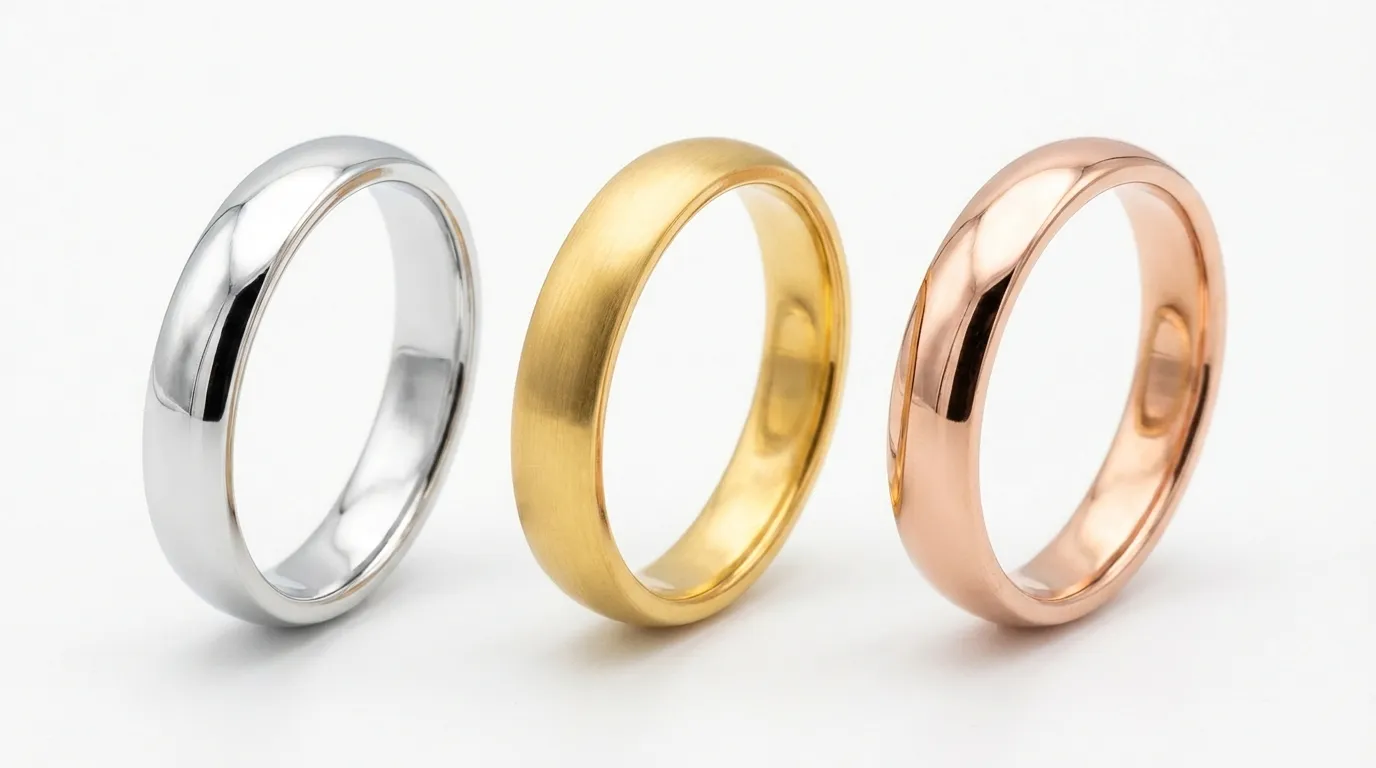
You’re looking at two rings that appear nearly identical — same stone, same setting, same price. The difference? One is rhodium plated, one is rose gold plated. Which should you choose?
The plating finish affects how your jewelry looks, how long it stays that way, and whether it works with your skin tone. Here’s what you need to know.
Quick comparison:
- Rhodium: Bright white/silver finish, most durable, best for cool-toned skin
- Gold plating: Warm yellow finish, moderate durability, universally flattering
- Rose gold plating: Warm pink/copper tone, romantic aesthetic, slightly less durable
Let’s get into the details.
What Is Rhodium Plating?
Rhodium is a rare precious metal in the platinum group. It’s used as a finishing coat on jewelry for three reasons: it’s extremely hard, it doesn’t tarnish, and its bright white finish makes diamonds and moissanite sparkle more.
Properties of rhodium plating:
- Color: Bright silver-white, cooler than white gold
- Hardness: Higher than silver, gold, or rose gold
- Tarnish resistance: Excellent — rhodium is non-reactive
- Hypoallergenic: Yes — completely nickel-free
- Re-plateable: Yes, by any jeweler
Rhodium is the most common finish on sterling silver jewelry because it solves silver’s main weakness: tarnishing. A rhodium coat over 925 sterling silver gives you the bright white look of white gold without the white gold price, plus a protective layer that slows oxidation dramatically.
If you’re buying a moissanite ring and want to maximize the stone’s brilliance, rhodium plating is typically the best choice — the cool white tone complements moissanite’s fire without competing with it.
What Is Gold Plating?
Gold plating applies a thin layer of gold alloy over the base metal (usually 925 sterling silver in quality jewelry). The result is the warm yellow-gold look at a fraction of solid gold’s cost.
Properties of gold plating:
- Color: Warm yellow gold — depth varies with micron thickness
- Hardness: Moderate — softer than rhodium
- Tarnish resistance: Good, but wears through over time
- Hypoallergenic: Generally yes, if nickel-free gold alloy is used
- Re-plateable: Yes
The thickness of gold plating matters. Measured in microns (micrometers):
- 0.5 microns: Budget tier — wears through quickly
- 1–2 microns: Standard quality — 1–2 years with daily wear
- 2.5+ microns: Heavy plating — more durable, longer lifespan
Quality gold plating over 925 sterling silver is not “fake jewelry” — it’s a legitimate jewelry-making technique used by premium brands worldwide. The base metal is real silver; the plating is real gold alloy. The key is whether the base is solid sterling silver or a base metal like brass.
What Is Rose Gold Plating?
Rose gold gets its distinctive pink tone from a higher copper content in the gold alloy. The more copper, the deeper the rose/blush color. It’s the same principle as solid rose gold — just applied as a plating layer over 925 sterling silver.
Properties of rose gold plating:
- Color: Warm pink to blush, depending on copper ratio
- Hardness: Moderate — similar to yellow gold plating
- Tarnish resistance: Fair — copper is more reactive than other alloys
- Hypoallergenic: Check — some rose gold alloys include nickel; look for nickel-free
- Re-plateable: Yes
Rose gold has a romantic, vintage-inspired aesthetic that’s been consistently popular for the past decade. It pairs particularly well with moissanite — the warm tone of the metal softens the stone’s fire without clashing.
The tradeoff: copper’s reactivity means rose gold plating is more sensitive to sweat, perfume, and chlorine than rhodium or yellow gold.
Durability Comparison
| Plating | Typical Lifespan | Hardness | Tarnish Resistance | Reactivity |
|---|---|---|---|---|
| Rhodium | 1–3 years | Highest | Excellent | Very low |
| Gold (2+ micron) | 1–2 years | Moderate | Good | Low |
| Rose Gold | 6–18 months | Moderate | Fair | Moderate (copper) |
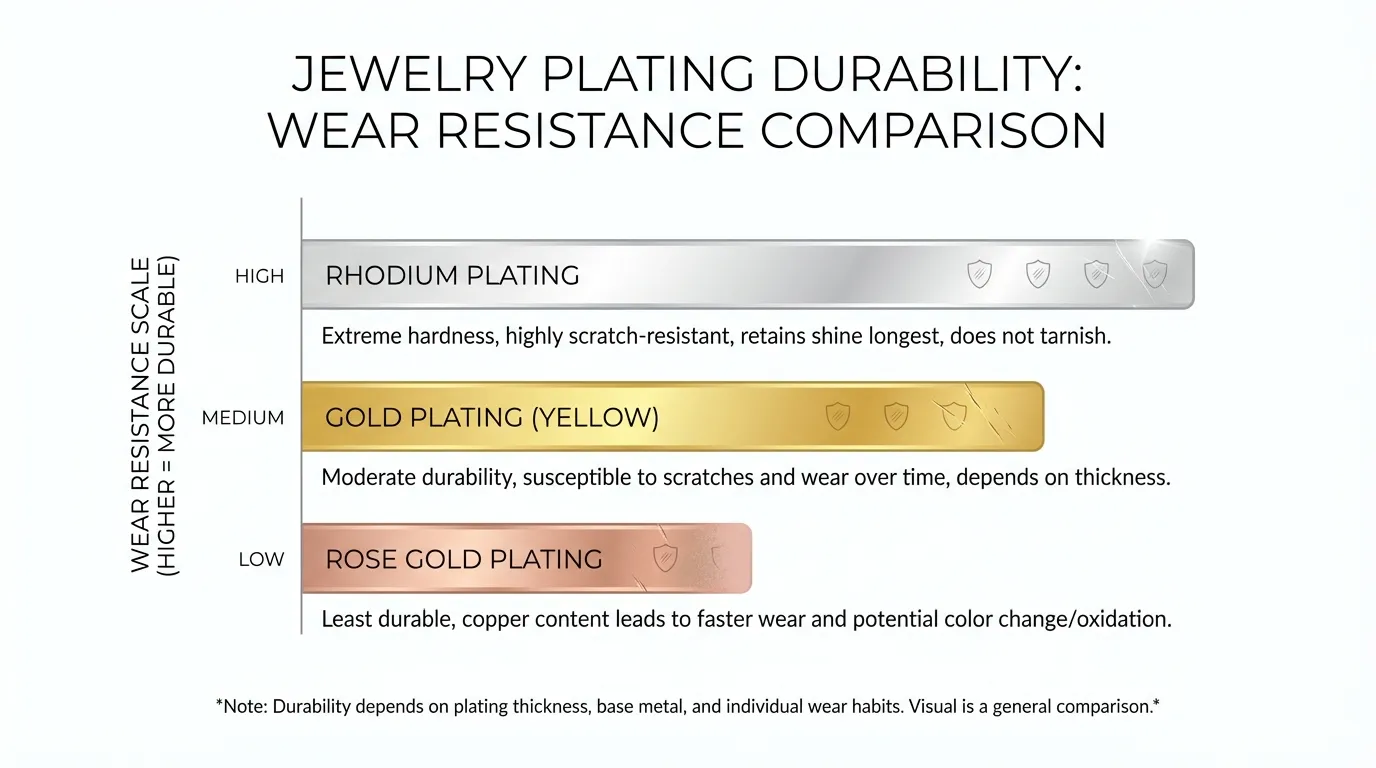
The ranking: Rhodium > Gold > Rose Gold for pure durability and maintenance requirements.
That said, “durability” in this context means resistance to wear-through — not brittleness or breakage. All three platings are applied over 925 sterling silver, which is the structural component. When plating wears, the silver underneath remains intact. Re-plating is a simple, low-cost process any jeweler can perform.
How to Choose Based on Skin Tone
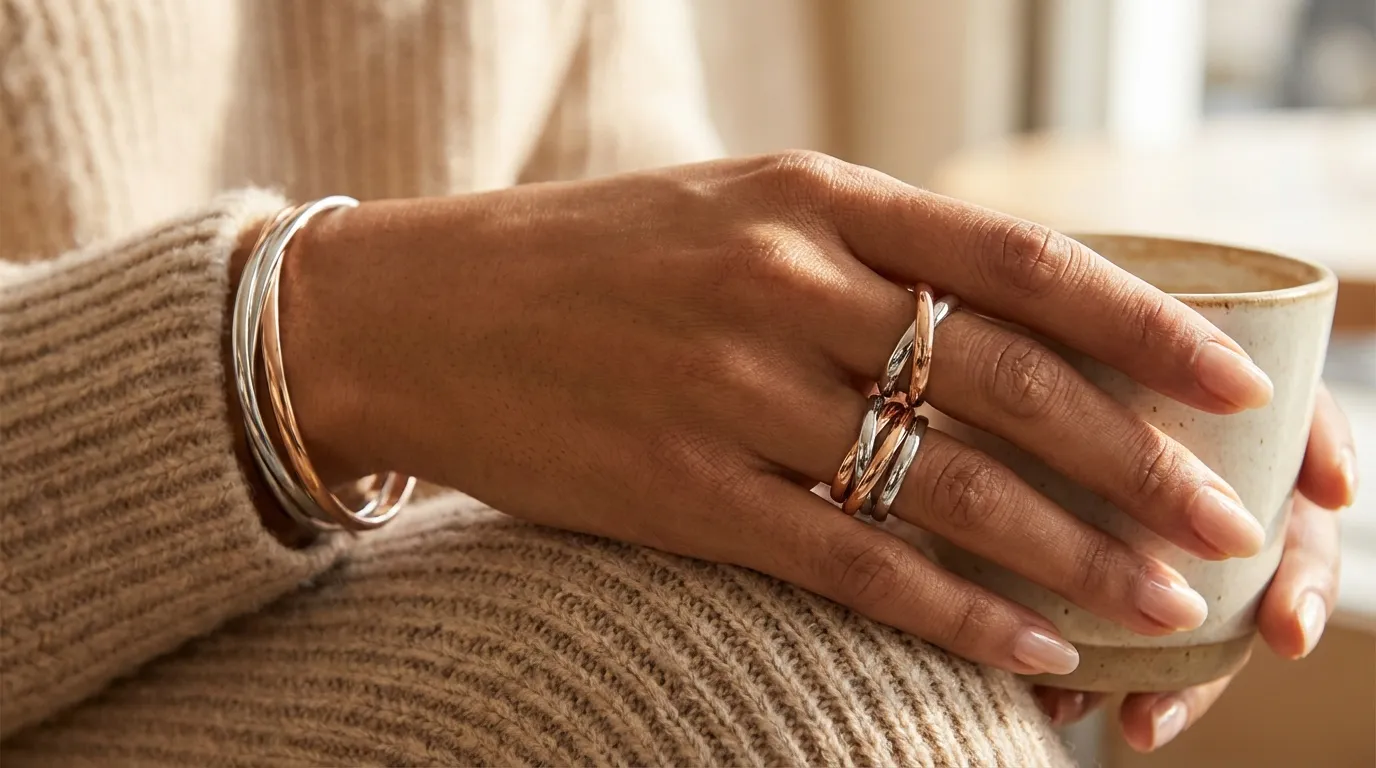
Skin tone is a practical consideration that most jewelry guides skip over. Here’s a straightforward framework:
Cool skin tones (pink or blue undertones — veins look purple/blue):
- Rhodium plating tends to be most flattering
- White gold plating also works well
- Rose gold can look slightly clashing
Warm skin tones (golden or olive undertones — veins look green):
- Yellow gold plating tends to be most flattering
- Rose gold also pairs beautifully
- Rhodium can look stark but still works
Neutral skin tones (mix of both):
- All three plating options work well
- Personal preference is the main guide
This isn’t a strict rule — plenty of people wear rhodium with warm skin and gold with cool skin. But if you’re choosing between two pieces and can’t decide, skin tone is a useful tie-breaker.
How to Maintain Plated Jewelry
All three platings require similar basic care:
Extend plating life:
- Put jewelry on last, after perfume and hair products
- Remove before swimming, showering, or exercising
- Store in separate pouches to prevent scratching
- Wipe with a soft cloth after wearing
What damages plating fastest:
- Chlorine (pool water, bleach)
- Salt water
- Sweat (especially for rose gold — copper reacts)
- Abrasive cleaners
- Ultrasonic cleaners (can crack plating)
For 925 sterling silver care beyond plating maintenance, read our complete sterling silver care guide.
What Goldmacher Offers
All Goldmacher jewelry is built on a 925 sterling silver base with your choice of plating finish. Our pieces are nickel-free across all plating types — including our rose gold options, which use a copper-tin alloy instead of copper-nickel.
This matters for anyone with sensitive skin. The nickel-free commitment applies to both the silver base and the plating layer — not just one or the other. See our hypoallergenic jewelry guide for more on what makes jewelry safe for sensitive skin.
The Bottom Line
All three finishes are legitimate, beautiful, and practical for daily wear when applied over quality 925 sterling silver:
- Choose rhodium if you want the most durable finish, prefer a cool white look, or want to minimize maintenance
- Choose gold plating if you want a classic warm tone and balance between durability and aesthetics
- Choose rose gold if the warm pink aesthetic matches your style — just be prepared for slightly more frequent re-plating
No finish is objectively “best.” The right choice depends on your look, your lifestyle, and how much maintenance you want to do.
Browse our collections to see all three finishes: rings, necklaces, earrings, and bracelets — all built on nickel-free 925 sterling silver.